You are here:
Comments Elsewhere: comments tagged Smash the State
Re: Tomorrow and Tomorrow (posted 27 September 2008)
- in reply to Tomorrow and Tomorrow, at Austro-Athenian Empire
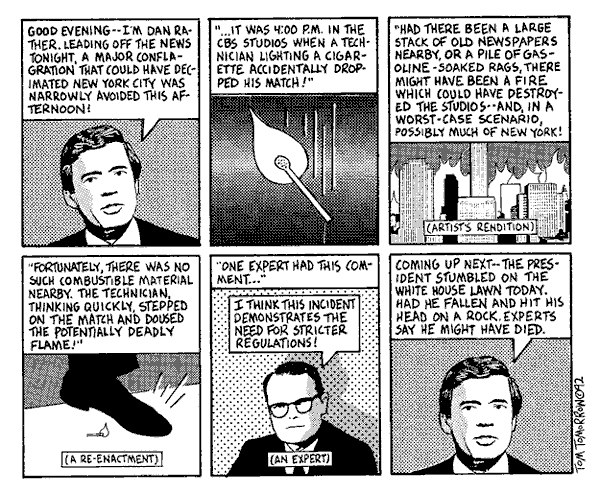
Found it! The comic you seek is “Dan Rather” (1992).

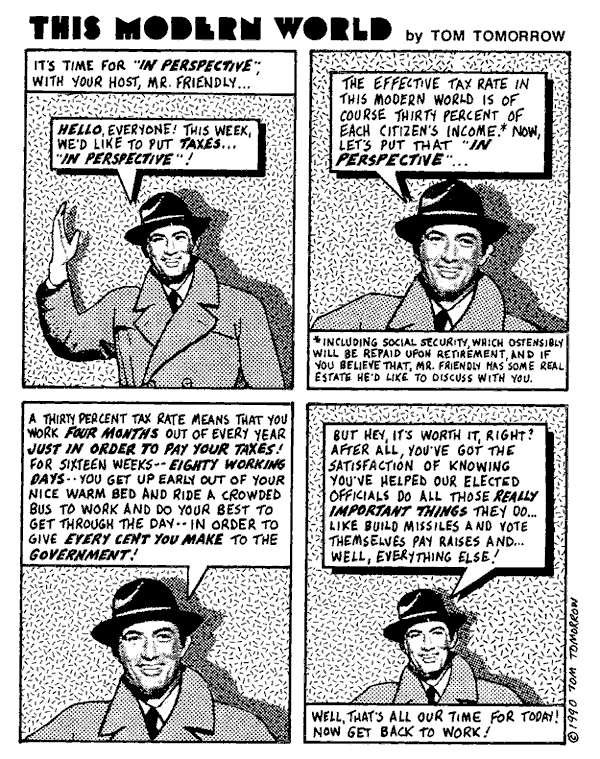
While I was looking through the archives, I also found this strip from 1990.

Re: Labor Unions And Freedom Don’t Mix (posted 29 August 2008)
- in reply to Labor Unions And Freedom Don’t Mix, at Philaahzophy
You are aware, aren’t you,
… that those same labor laws which provide privileges to NLRB-recognized unions by forcing employers into collective-bargaining also heavily regulate the methods that NLRB-recognized unions can adopt, and the goals that they can achieve? That, for example, under Taft-Hartley, legally-recognized unions are forbidden from striking except under a limited range of government-approved conditions, that they are legally prohibited from establishing union hiring halls or freely negotiating a closed shop contract with employers, that in many states (under so-called “right to work” laws) they are legally prohibited from freely negotiating a union shop contract with employers, that they are legally prohibited from promoting secondary boycotts or engaging in secondary strikes (i.e. boycotts or strikes against a company for doing business with a second company workers have a grievance with; this prohibition effectively bans general strikes and mandates union scabbing), that strikes can be (and have been) broken by the arbitrary fiat of the President of the United States, etc., etc., etc.? In fact, while some factions of the labor movement (especially the AFL and the nascent CIO) actively lobbied for the Wagner Act and the system of state patronage that it created, other, more radical factions of the labor movement were stridently opposed to it, arguing (correctly) that Roosevelt’s plan was an effort to subsidize bureaucratic conservative unionism, and thus to capture and domesticate the labor movement. And predicting (accurately) that the practical consequences of the NLRB system would be to substantially hamstring the labor movement, and to benefit only a few fatcat union bosses, at the expense of rank-and-file workers.
… that for about half of its history (from the founding of the Knights of Labor in 1869 up to the Wagner Act in 1935), the American labor movement operated in a political and legal environment where it had no government recognition, no government privileges, and in fact was repeatedly, violently attacked by injunction-wielding judges, by the police, the military, by the U.S. Marshalls, by President Woodrow Wilson and Attorney General Alexander Mitchell Palmer and a young J. Edgar Hoover, by state militias, private “security” companies, and mobs? That radical unions like the IWW nevertheless managed to organize hundreds of thousands of workers in spite of this unrelenting violence and to win, without any use of government privilege, substantial victories in towns like Lawrence, Massachusetts and Spokane, Washington? I conclude that labor unions can be quite effective when based on free association and without government privilege.
If the conclusion you’re trying to urge here is just that the NLRB and the AFL-CIO are statist, well, sure. Who denies that? Certainly not the NLRB or the AFL-CIO, who candidly declare their allegiance to a big, interventionist government; and certainly not pro-union anarchists, either, who generally refer to establishment unionism as “labor fakirs” deserving nothing but scorn, and advocate for radical unions organized along quite different lines, and with quite different aims.
If, on the other hand, you’re trying to establish some more general conclusion, like (say) “Labor Unions and Freedom Don’t Mix,” or that “the state is the first weapon in the labor union’s arsenal to be wielded against employers and workers alike,” or that “the ultimate dream of the labor unions is to completely replace the existing state, allowing them to force their will on 100% of the people 100% of the time,” i.e., a claim about what labor unions per se do and want, rather than what a temporarily triumphant, government-subsidized faction within the labor movement does and wants, but which other, competing factions within the labor movement have repeatedly condemned, then I can’t say you’ve offered much by way of convincing evidence for that conclusion.
As for Bakunin and his followers, I certainly have my disagreements with Bakuninist collectivism. (That’s why I’m an individualist, or a mutualist, rather than a collectivist.) But you’re distorting their position. Bakunin’s idea of federated labor unions is not a replacement state. He believed that the best arrangement for society was a federated structure of workers’ and community associations. But he also believed in an absolute right to dissociate from any union or other association that one did not want to participate in or cooperate with. Thus: “[W]ithout certain absolutely essential conditions the practical realization of freedom will be forever impossible. These conditions are: […] The internal reorganization of each country on the basis of the absolute freedom of individuals, of the productive associations, and of the communes. Necessity of recognizing the right of secession: every individual, every association, every commune, every region, every nation has the absolute right to self-determination, to associate or not to associate, to ally themselves with whomever they wish and repudiate their alliances without regard to so-called historic rights or the convenience of their neighbors.” (Revolutionary Catechism, 1866). Etc. Bakunin’s problems, such as they are, lie elsewhere. May I gently suggest that, if you want to find out Mikhail Bakunin’s views, you might be better off reading works by Mikhail Bakunin, rather than summaries of those works by Per Bylund?
As for Joe and his workers, I certainly agree that Joe should not be forced by the government (or by any form of violence) to engage in collective bargaining with the striking workers. However, I think you’re walloping on a strawman, as far as the worker’s demands go (do you know of any strike, even under the existing statist labor bureaucracy, in which workers demanded a 400% wage increase?); and I think you’re also pretty severely overestimating the ease of replacing 25%-40% of the workers on the shop floor all at once, especially if you’re trying to accomplish this without offering substantially higher wages or improved conditions. In real-world labor struggle, being in a position where you can get 25% or more of the workforce ready to just walk off the job often puts you in a very good position for getting substantial concessions from the boss.
The union makes us strong (posted 24 May 2008)
Micha,
Thanks for your thoughtful comments.
I agree with you that worker ownership of the means of production wouldn’t instantly solve all the problems of labor, and that — for all I’ve said in the King Ludd post — there might be other reasons why it turns out not to be viable, or at least not universally practicable. My main point was just to show that one alleged problem with unionism, presented by De Coster and others as if it were intrinsic to unionism as such, was actually only a problem with the particular model of union organizing that both anti-union business types and the establishmentarian union bosses fetishize, and which the Wagner/Taft-Hartley system actively subsidizes and protects in the name of “industrial peace,” at the expense of competing organizing models — like, for example, the worker-ownership model of the IWW. Those other organizing models may have problems of their own, but they don’t have the problems that De Coster treats as intrinsic to unionism.
After all, one of the myriad justifications for profits going to the capitalist is that the capitalist takes on the most risks, using her own money as an entrepreneur to start an uncertain business, with a high failure rate, and also extending in time when she will get recompensated, assuming the business becomes successful. Whereas a poor laborer just scratching by may not have the wherewithal to take such a large risk, nor be willing or able to withhold present consumption for the chance at a bigger future payoff - the poor laborer just wants a certain payoff now, in the form of wages.
Well, O.K., sure, but two things.
First, insofar as this argument works, it seems like it’s an argument for capitalists to take a role and get a cut in the high-risk start-up period for a firm; not necessarily much of an argument for capitalists remaining as residual profit recipients after the firm is already well established. It’s perfectly possible to have both an infusion of working capital during the start-up period and a worker co-op at the end (either because the capitalist agrees to those terms, going in, or because the workers organize after a while and use their stronger bargaining position to convince her to disentangle herself and find a new entrepreneurial opportunity). The question is why that sort of thing doesn’t happen now. Maybe it’s because there’s some other reason why it’s not viable, but I’d suggest that a lot of the reason has to do with the way in which prevalent business models and prevalent union organizing models are supported and rigidified by government economic regimentation (as well as the establishmentarian business and union culture that that regimentation promotes).
Second, it’s true that, especially for very low-paid wage workers, a lot of their economic decisions are going to be made as a reaction to the extremely precarious economic situation that they are in. This will naturally tend to make people more risk-averse and more interested in certain and quick pay-offs than they might otherwise be. But the precarity isn’t a fixed natural fact; it’s largely the product of specific government policies which ratchet up fixed costs of living while ratcheting down opportunities for homesteading and labor, with workers’ livelihoods caught in the squeeze. Eliminate those policies and you’ll begin to see workers with more of their costs of living safely covered and with more in the way of back-up options should their current arrangement fail.
But becoming an investor and a risk-taker generally presupposes some level of acquired wealth, where you have taken care of basic needs and have some money left over to risk and save. Poor laborers aren’t generally going to have access to that sort of capital, and they are the ones who seem to benefit from organizing their labor the most.
Well, organizing your labor and providing a cushion of wealth to fall back on aren’t mutually exclusive options. Unions themselves can (and, in the past, often did) provide an institutional vehicle for helping cushion workers from economic falls — by improving wages, but, more importantly by providing institutions that help workers on the bum to find new work (e.g. union hiring halls, now illegal under Taft-Hartley) or for workers to help each other provide for themselves and their families during lean times (e.g. mutual aid societies, now partly illegal, or heavily regulated — if they do anything that might be construed by the government as selling insurance — and in any case crowded out by government welfare).
If it turns out that one aspect of radical labor solidarity (worker ownership of the means of production) works out best when accompanied by another aspect of radical labor solidarity (a vibrant network of mutual aid), well, I’m happy enough with that conclusion.
Re: Socioeconomic Creationism (posted 9 May 2008)
- in reply to Socioeconomic Creationism, at The Distributed Republic
Micha:
Lots of intelligent redistributionist socialists argue along the same lines; it’s not that they don’t understand how markets and spontaneous orders work; they simply don’t care ….
Right, which is why they don’t provide a good example of someone who falls back on government causes of poverty by explanatory default, either. Their position is wrong, but not because they (like biological creationists) fail to understand the concept of spontaneous self-organizing systems.
Serious Marxist theory, for example, actually involves quite sophisticated use of the concept of spontaneous order in explaining the emergence, sustenance, internal conflicts, and ultimate collapse of the capitalist class structure. (The idea is certainly not that all the evil capitalists got together in a big meeting and made a big plan for taking over the world and exploiting the workers. Any serious Marxist theorist would very quickly trash a theory like that as a form of “utopian socialism” and a case study in “bourgeois individualism.”) Of course, most of serious Marxist theory (as well as Cohen’s egalitarianism) is wrong, but it’s wrong for reasons other than being somehow “creationist.”
There are lots of people who do fail to get the concept, but they’re mostly concentrated among the most vulgar of vulgar Marxists, and the usual lot of nativist pseudo-populists, economic conservatives, and Social Democrats who take up most of the space in mainstream American political debate. None of whom, as far as I can recall, have ever leaned much on the government as a supposed cause of poverty or socioeconomic inequality. (Conservatives who make the typical conservative arguments against AFDC/TANF and other forms of government welfare may be an exception; but they don’t claim that urban poverty is being caused by deliberate government efforts to create it. And they rarely say that poverty as such is caused by government action. They take urban poverty as we know it more or less for granted and then claim that government welfare programs make it worse.)