You are here:
Comments Elsewhere: comments tagged Roderick Long
Re: Tomorrow and Tomorrow (posted 27 September 2008)
- in reply to Tomorrow and Tomorrow, at Austro-Athenian Empire
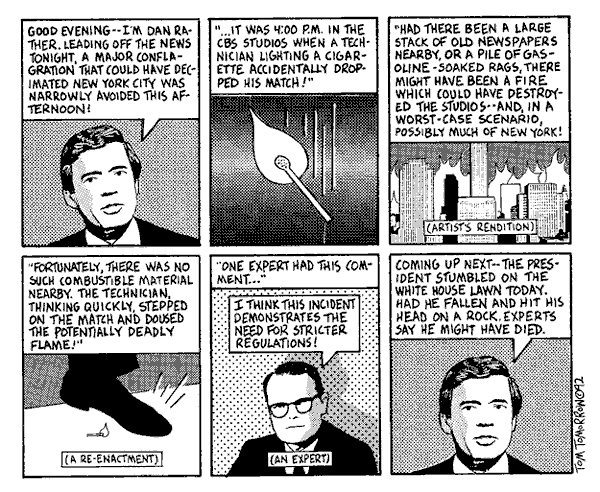
Found it! The comic you seek is “Dan Rather” (1992).

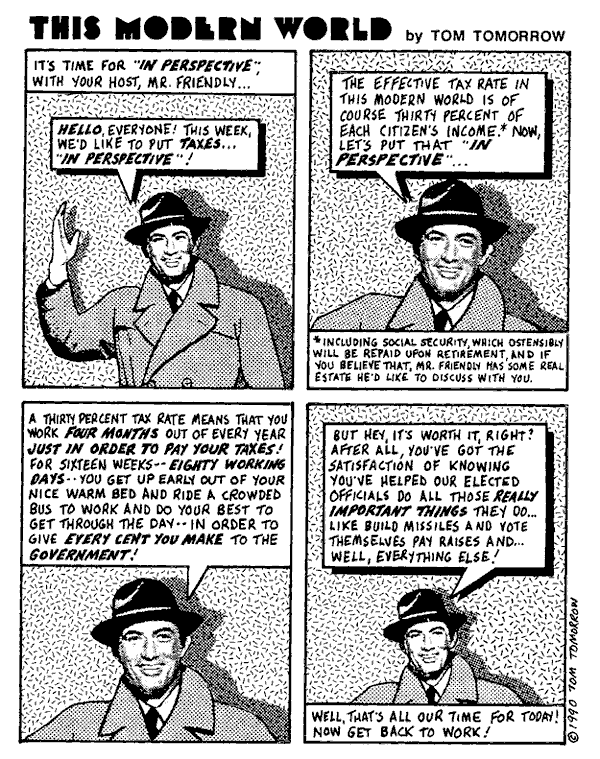
While I was looking through the archives, I also found this strip from 1990.

Re: Thickness unto death (posted 12 July 2008)
- in reply to Thickness unto death, at Austro-Athenian Empire
Roderick:
So one can nonthickly argue that it’s not that case that we must be thicklib. But one can’t non-thickly argue that it is the case that we shouldn’t be thicklib.
Well, thick libertarianism is the claim that libertarianism as such provides good reasons for libertarians to care about other commitments besides a rigorous commitment to non-aggression. So it’s true that if, for example, a would-be thin libertarian is arguing that we should abandon a particular nonviolently held philosophical view about libertarianism (viz. the thick conception of it) for, e.g., reasons of libertarian strategy, then she is really advancing a form of thick, not thin, libertarianism.
But couldn’t a woud-be thin libertarian instead argue that we ought to abandon a particular nonviolently held philosophical view about libertarianism (viz. the thick conception of it) for other reasons distinct from and alongside our libertarian commitments? For example, that it should be abandoned for reasons of intellectual clarity, considered as desirable in itself rather than as a means to libertarian triumph or whatever else?
If so, then, while I would certainly disagree with the argument for abandoning a thick conception of libertarianism, I wouldn’t think that the argument is internally contradictory. The appeal only becomes an appeal to thickness if the reasons being given are reasons that the libertarian is supposed to have qua libertarian, rather than (for example) qua philosopher or qua clear thinker.
Re: Plus or Minus (posted 12 July 2008)
- in reply to Plus or Minus, at Austro-Athenian Empire
William:
We may not be able to directly speak of “all that really matters,” but we can get closer and closer by refusing to hold to our existing macroscopic abstractions.
Are you claiming that something like, say, the loaf of cornbread that I stuffed into my mouth earlier today is a “macroscopic abstraction,” whereas stuff like, say, up and down quarks are not abstractions, but rather concretes?
Really?
Re: Farewell LP (posted 25 May 2008)
- in reply to Farewell LP, at Austro-Athenian Empire
Re: Never Walk Alone (posted 23 May 2008)
- in reply to Never Walk Alone, at Unqualified Offerings
dhex,
Well, “politics” derives from the Greek root “polis.” At the time the word was made, “polis” was ambiguous between (or consistently conflated) (1) the organized government of the city, and (2) civil society within the city. So when Aristotle wrote about “politics” he was talking about government processes, but about public life broadly, including many institutions within the city (religious, civic, educational, etc.) which today would be thought of as part of the private rather than the government sector.
Nowadays most people use politics to refer mainly or only to the business of the government, but some traditions (especially on the Left and in the feminist movement) use “politics” in a broader sense to include not only government processes but also struggles within civil society, especially if they have a common impact on a lot of people and if the civil society dynamics are structured by the balance of power between different social classes (such as men and women, or white people and black people, or…).
So “political” is not being expanded so far as just to mean “affects other people” (presumably remembering your friends’ birthdays affects other people, but I wouldn’t call it a political commitment); rather, “politics” is being being used to describe anything that acts to systematically structure public life in terms of the power relationships between groups of people. That includes governmental processes but it also includes a lot of other things, such as the way in which rape dramatically constrains the freedom of movement of all women, as women, and puts women in a state of greater dependency upon men.
Does that help clarify?
Incidentally, I’ve discussed the use of the term “politics” at some more length in section 2 of the Libertarian Feminism essay that I co-authored with Roderick Long.
Re: Socioeconomic Creationism (posted 7 May 2008)
- in reply to Socioeconomic Creationism, at The Distributed Republic
For example, if some have much more wealth than others, the socioeconomic creationist believes that this is the product of government policies specifically designed to transfer wealth from the many to the few, rather than the natural result of market transactions between people of disparate abilities and preferences.
Well. Isn’t it empirically true that there are specific government policies which, either through design or through unintended consequences, tend to profit the rich, hinder and impoverish the poor, or do both at the same time? If you doubt it, I can name some examples.
Can you think of any actual examples of people who fall back on the claim that poverty is substantially caused by government policies, rather than by voluntary market forces, who do so because they’re simply unable to understand how spontaneous orders work? Every proponent of such a claim that I can think of (Kevin Carson, Roderick Long, Brad Spangler, Benjamin Tucker, Lysander Spooner, Gabriel Kolko…) is relatively clear on the notion of spontaneous order; they get to the conclusion that government policies cause poverty not by explanatory default, but rather because they can point to a bunch of concrete examples of government policies that really do this.
In my experience, most of the real “socioeconomic creationists” with regard to wealth, tend to attribute poverty to tightly coordinated conspiracies (“international bankers” and the like), or else to the personal greed and vices of individual business people, not to structural factors like government policy.
If the average man makes more than the average woman, the socioeconomic creationist concludes that this must be due to the misogynistic oppression of women, rather than the natural outcome of men and women having different preferences, opportunity costs, and/or abilities.
You seem to be presupposing that “misogynistic oppression of women” and “spontaneous order” are two mutually exclusive explanations of the situation. But why make that claim? There’s nothing in the concept of a spontaneous order that requires that all spontaneous orders be benign. It may be that if certain kinds of ignorance, folly, or vice are widely distributed throughout the population, then lots of little individual acts of stupidity or evil will, without the design of the participants, add up to a large-scale, malign spontaneous order that goes beyond the intentions of the participants.
“Preferences, opportunity costs, and/or abilities” aren’t the only factors that can contribute to the individual decisions from which a spontaneous order emerges. And not all “preferences, opportunity costs, and/or abilities” are independent of prevalent prejudices and traditions, either.
Self-described libertarians (posted 18 March 2008)
- in reply to Jesus effing Christ, at fromaway's LiveJournal
Thanks for the mention, and for the kind words. I agree about the tone of that OC Weekly article. It’s kind of baffling, because the analysis is actually so much better than the analysis in most abusive-cop pieces, but the tone comes off as if it were written by a fugitive from a direct-to-video American Pie script.
As for self-described libertarians, what I’ve found is that they (we) are a pretty diverse lot. A lot are tools or creeps, and especially those “small government” types whose views are conventional enough to fit into the outer fringes of mainstream political discourse. But, while I don’t want much to do with those folks, radical libertarians tend to be a very different sort, and those that I get along with and try to learn from (e.g. Roderick Long, Kevin Carson, Jennifer McKitrick, Carol Moore, Anthony Gregory, Sheldon Richman, Brad Spangler ….) are generally maneuvering to out-Lef the establishment Left, in terms of exposing the class dynamics of the State and making a case for radically decentralist, grassroots approaches that achieve Leftist and feminist goals by ordinary people getting together amongst themselves, and bypassing or confronting the State, rather than collaborating with it or trying to seize control of it. Maybe that approach is the right approach, and maybe it’s the wrong approach; but in any case it’s a very different approach from the one that you’d be likely to see from the “small-government conservative” types, or at your local Libertarian Party, or in your average MeetUp for Chairman Ron’s Great Libertarian Electoral Revolution. And it’s an approach that more libertarians seem to be adopting lately; a tendency which I hope I might be able to encourage, in whatever small ways I can manage.
Anyway, that’s how I see it now. Does that help clarify, or does it muddy?
Re: Fifth Business (posted 13 March 2008)
- in reply to Fifth Business, at Austro-Athenian Empire
JOR,
The same. The original essay is available online; cf. also GT 2003-09-30: Why There Are No Arguments for Terrorism for my responding to Honderich with a certain gesture of the hands.
Re: Two Guys Who Loved Them Some Stock Exchange (posted 6 March 2008)
- in reply to Two Guys Who Loved Them Some Stock Exchange, at Austro-Athenian Empire
Re: The Ron Paul Flap - Short Version (posted 24 January 2008)
- in reply to The Ron Paul Flap - Short Version, at No Treason!
Libertarian outreach by whom? By me in particular or by libertarians in general?
If the former, then I would find libertarian outreach to leftists much more palatable for me to do than libertarian outreach to white supremacists, because I know how to talk to state leftists in a way that some small number of them will find convincing, whereas I don’t really know how to talk to white supremacists in general, let alone statist white supremacists in particular, and I think it would be extremely unpleasant to learn.
If the latter, then I have much weaker preferences, because I think generally if people are going to do outreach they should specialize in what they are best at. But I would suggest that outreach to state leftists may be more likely to succeed in the long term than outreach to state white supremacists, because both of them tend to share the common cognitive or moral vices of statists (majoritarianism, legalism, constitutionalism, contempt for private property rights), but the state white supremacists tend to add some peculiar vices of their own on top of that (e.g. violent racism or xenophobia). Turning state leftists in an anti-state direction tends to produce anarchists, whereas turning statist white supremacists in an anti-state direction tends to produce paleocons at best.
In either case, I’m not sure what this has to do with the question of whether racism or majoritarianism is (1) more offensive, or (2) more dangerous. I’d rather have dinner with a polite absolute-monarchist than with a very rude individualist anarchist. Not because I think that rudeness is worse than absolute monarchy, but rather because other factors enter into my decisions about who I should dine with. Similarly, decisions about who you should reach out to in your propaganda are not necessarily decided solely based on whose deviations from your position you consider to be the least dangerous or destructive.